Burke murders Kane Asche
The AxBurke murders Kane Asche after watching him and his wife work together in their garden and waiting for an opening to attack. When the couple’s closeness frustrates his plan to isolate Asche, Burke resolves that both may have to die; instead, he later finds Asche alone at a mall nursery and kills him beside the open trunk of a black Honda Accord. The episode shifts Burke’s campaign from surveillance and conditional planning to an exposed, bloody act of violence, followed by a quiet drive home.
Surveillance and the Desired Opening
On Thursday, Burke returns to the roadside above the Asches’ property in the Voyager. From the height of the parked vehicle, he watches the couple stake the ground, bring out flats of seedlings, dig, and plant. Their repeated exchanges—handing one another things, talking, sometimes laughing—make their togetherness the obstacle he cannot work around. He resents not only their cooperation but the daily continuity it represents, as they keep moving through their tasks while he waits unseen above them.
Burke has arrived before nine. The Honda Accord is already in the driveway, but the couple do not come outside until about nine-thirty, dressed for gardening. He watches them work through the morning and waits for one to separate from the other. His plan depends on a brief interval: if the wife goes indoors and appears likely to stay, he will take the Luger from beneath a raincoat on the passenger seat, walk down, and shoot Asche. If Asche leaves in the car, Burke will follow and kill him; if his wife leaves, he will approach Asche in the garden. The alternatives reveal how thoroughly he has converted their ordinary movements into a set of possible openings for murder.
The calls on a cordless phone do not provide that opening. Twice, Burke sees the wife answer; one call is for her, while on the other she hands the phone to Asche. Neither call draws either person away into the house. Burke compares the distant scene to a Japanese art movie and casts himself as a bandit watching from the hill, but the imagined theft of a harvest has become an intention to kill. The contrast between the couple’s shared labor and his patient, concealed observation gives the scene its tension: nothing outwardly dramatic happens, yet every routine action is measured against his plan.
From Waiting to a Decision
Burke’s frustration grows into a judgment about what the couple’s closeness requires. He says he cannot accommodate their togetherness indefinitely and fears killing the wife, a decision he associates with his earlier horror at deciding to kill a boyfriend. But he presents a more urgent fear as his own transformation: remaining in this process too long, he believes, is changing him into someone he could not stand to be around. He imagines a future job in Arcadia as a chance for that change to bleach away, and treats finishing the murders as the condition for reaching it.
On the morning he drives toward Dyer’s Eddy, he makes the decision he had resisted. If the Asches insist on living together every second of every day, he concludes, they will have to die together. The resolve is not described as easy or casual; Burke calls it solid and unswerving. The night before, he had awakened in pitch darkness with a sudden terror and eventually understood that he was afraid of himself. That recognition shadows the plan: he wants the violence over because he fears what it is doing to him, yet answers that fear by making a firmer commitment to violence.
When he turns onto Footbridge Road, the Accord is no longer in the driveway. He wonders whether the couple have driven off together and regrets his late start. But the wife is still in the garden, wearing a pale yellow T-shirt and white headband, with a clipboard on which she seems to be drawing a chart of the garden. The separation Burke had been waiting for has not resolved the danger or ended his pursuit. The car’s absence instead leads him to look for Asche elsewhere.
The Shooting at the Nursery
At a mall, Burke spots the black Honda Accord near the entrance to the nursery. He recognizes it as the car he has been tracking and watches from the Voyager. Because there is no adjacent parking space, he parks several spaces away. He puts on the raincoat and transfers the Luger to its right pocket, keeping the weapon hidden as he waits. The small, ordinary business of the lot—a shopper loading packages into a green Ford Taurus and returning her cart—unfolds beside his focus on the Accord and on whether Asche has appeared.
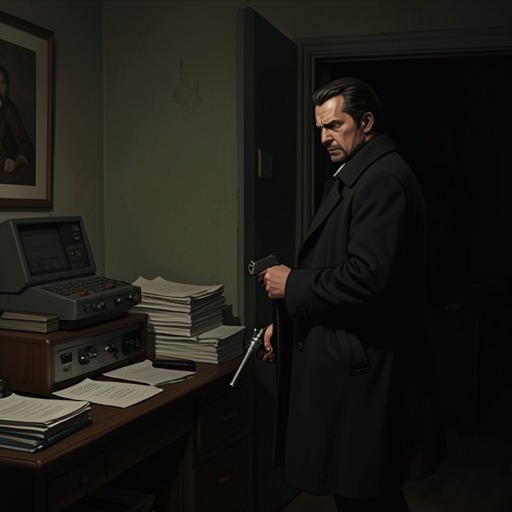
After ten minutes, Asche comes out pushing a cart loaded with small boxes, white plastic shopping bags, and a large sack of peat moss. He opens the trunk, wrestles the peat moss inside, and bends beneath the raised lid to arrange the other purchases around it. Burke gets out, holds the Luger against his leg, walks between the cars, and stops behind him. He asks whether he is Kane Asche. When Asche turns with a questioning smile, Burke answers that he knows who he is and raises the pistol from beneath the raincoat. The fabric bunches around his wrist and pulls his arm down slightly; the first bullet strikes Asche’s right cheek rather than his eye.
The wound does not kill Asche at once. He falls backward, partly into the trunk and partly across the rear bumper, his eyes staring. Burke recognizes that the shooting is messy and that Asche is still alive. He leans closer and fires again, holding the barrel almost against Asche’s right eye. Asche’s head snaps back; he is left sprawled mostly on his back, mouth open, one eye open. The failed first shot makes the killing more immediate and brutal than Burke’s controlled plans had allowed for, but he does not stop or retreat before firing again.
Departure and Significance
After the second shot, Burke walks back to the Voyager without hurrying. He leaves the Luger in his lap, covered by the raincoat, starts the vehicle, reverses out of the space, and drives away. The account notes little traffic on the way home. Its subdued closing contrasts with the sudden violence at the nursery: Burke returns to the ordinary road and ordinary car without any narrated confrontation or interruption. The episode ends with his escape from the scene, not with any account of investigation or later consequences.
The murder’s central reversal lies in the difference between Burke’s elaborate conditions and the act he finally performs. He had watched the Asches for an opportunity to separate them and had contemplated killing both if their togetherness persisted. At the nursery, he finds Asche alone and acts in public, amid cars and shopping, rather than in the garden he had studied. His stalking turns domestic work, a missing car, and a load of gardening supplies into a chain of practical cues. The ordinary details do not soften the murder; they show how completely Burke has made another person’s daily life legible as a target. His fear of becoming someone he cannot tolerate therefore remains unresolved: instead of escaping the process, he has carried it through another deliberate killing.